A Dressing Table Display Built Around One Object
A dressing table display built around one object turns a meaningful keepsake into a calm focal point, with contrasting shapes that feel collected, not matched.
The most common mistake in a dressing table display is buying a matching set before deciding what deserves to be seen. The result can feel like a shop window, while a meaningful object stays tucked in a drawer; a better dressing table display starts with that one object and lets its shape guide the rest.
It might be a small ceramic dish from a relative, a carved wooden box, a shell picked up on a trip, or a bottle whose color you love. The point is not to make the object look expensive or historically important. It is to give it room, then add a few useful things whose shapes create an easy conversation with it.
Choose the anchor
Pick an object that feels personal and can sit safely on the surface. A sentimental piece is often a stronger anchor than a coordinated perfume bottle because it gives the display a reason to exist beyond decoration.
Notice its visual character before choosing anything around it. Is it tall or low, rounded or angular, matte or glossy, visually quiet or patterned? These qualities are more useful than trying to match its color exactly.
Also consider what the object can tolerate. A paper keepsake may need a frame or a spot away from splashes; a delicate shell may be better placed where it will not be knocked by a brush. If the anchor is too precious to handle casually, display it without making it part of the daily routine.
Build with contrast
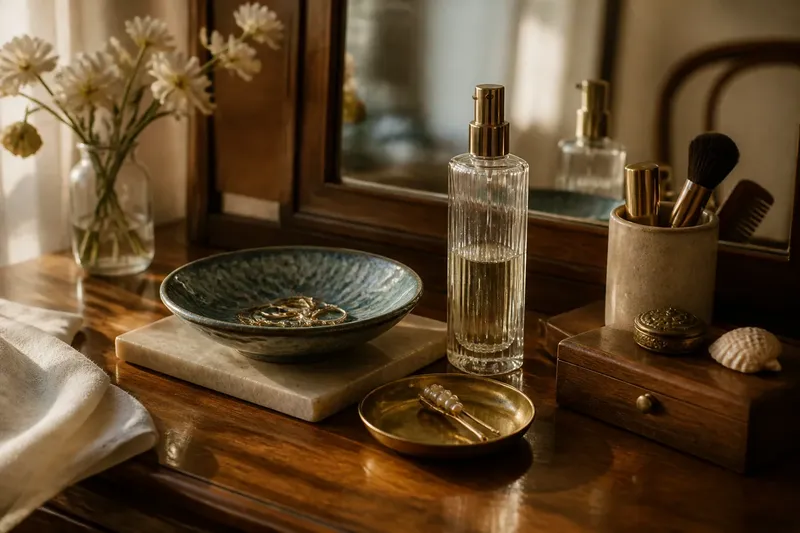
Contrast makes a small grouping feel collected rather than purchased as a set. Pair a rounded ceramic dish with a slim glass bottle, or set a squat wooden box beside a narrow brush cup. Let one form echo the anchor and another disagree with it.
Keep the number of objects modest. A few shapes can establish a clear focal point; a crowded row of bottles, jars, and trinkets makes the eye work harder and leaves less room to get ready. Useful items belong in the arrangement only if they help its balance or earn their place through regular use.
- Vary height: Place a taller bottle near a low dish so the outline rises and falls.
- Vary material: Combine, for example, glazed ceramic with clear glass, brushed metal, or wood.
- Vary shape: Set a rounded object beside a narrow cylinder or a crisp rectangular box.
- Repeat one detail: A small note of color or finish can connect the group without making every item match.
Say you have a shallow blue ceramic dish inherited from an aunt. You could place it near the back of the dressing table, add a clear perfume bottle with a tall silhouette, then set a small brass hairpin tray lower and to one side; the expected result is a display with three distinct outlines, where the dish remains the first thing the eye notices.
Give the grouping space
Position the anchor where it can be seen without blocking the mirror or the light you use to get ready. Leave a little open surface around the cluster, especially near the front edge where hands and makeup tools tend to move.
Think about the view from both the chair and the doorway. A display that looks balanced straight on may appear lopsided from the side, particularly if the tallest item sits at the far end. Turn the grouping or shift one piece until its outline reads clearly from the angles you use most.
Not every object needs to face forward. A bottle can show its side, and a box can sit slightly turned, as long as the arrangement does not look accidental. Avoid arranging every item in a straight line; a gentle stagger gives the group depth without making it fussy.
Keep function in view
A dressing table is a working surface, not a still life. Keep everyday products easy to reach, and move anything you use only occasionally to a drawer or nearby shelf. A display that constantly needs to be cleared before applying lipstick is unlikely to stay pleasant.
Check the surface for drips, powder, and loose hair as part of ordinary tidying. A small washable mat beneath a perfume bottle can protect a delicate tabletop, while a lidded box can contain pins or other tiny pieces. The materials and placement should suit the furniture and the item's care instructions.
What is not worth the effort is hunting for a perfect color match or buying extra decor to fill every gap. A little empty space helps the anchor stand out, and the display can change as your routines or interests shift.
Questions about styling?
How many objects should sit on the table?
Start with the anchor and add only a few contrasting pieces. If the grouping competes with the mirror or crowds the space you use, remove an object rather than adding another.
Can the anchor be something practical?
Yes. A jewelry dish, brush cup, or small box can be both useful and personal, provided its shape gives the arrangement a clear center. Keep daily essentials within easy reach instead of hiding them for appearance's sake.
What if the anchor is very colorful?
Let its color lead, then use calmer materials nearby, such as clear glass, natural wood, or plain metal. A small repeated detail can tie the pieces together without requiring an exact color match.
How can I refresh the display without replacing it?
Move the anchor to a different position, swap one supporting object, or take away a piece that no longer earns its space. The dressing table display built around one object can stay familiar while the surrounding shapes change with your routine.
Before adding anything new, try the anchor in the spot where you can see and use it comfortably. That small choice often tells you whether the display needs another shape—or simply more breathing room.