Retouching Does Not Make a Portrait Neutral
Retouching a beauty portrait shapes what viewers notice. Learn to describe smoothing, cropping, and lighting without treating the image as an ideal.
The most common mistake with retouching a beauty portrait is to call the finished image “natural” as if that means untouched. The label can hide choices about skin texture, framing, and light—and make one carefully constructed appearance seem like a neutral standard. A more useful description names what the image does.
Smoothing, cropping, and lighting are not simply technical steps that either reveal or distort a face. Each directs attention. The right language helps a viewer distinguish the portrait’s visual choices from claims about how people should look.
Retouching a Beauty Portrait
Retouching can range from subtle color correction to extensive alteration. Smoothing may soften visible pores or fine lines; cropping may remove the shoulders, clothing, or setting; lighting may brighten some features while leaving others in shadow. Together, these choices can make a face appear more uniform, polished, or dramatic.
None of those effects, by itself, tells you whether the image is good or bad. A beauty portrait might aim for intimacy, glamour, theatrical effect, or a close view of makeup. The question is what the choices emphasize and what they leave out.
It also helps to separate a description from an interpretation. “The skin texture has been softened” describes a visible effect. “The image presents flawless skin as the ideal” makes a broader claim about meaning, one that needs more context than a single editing choice.
Three Editing Approaches
Keep texture visible
A portrait that preserves pores, freckles, and fine lines can draw attention to the face as a particular person rather than a polished surface. This approach suits editorial work that wants makeup, expression, or skin detail to remain legible. It does not mean the image has no edits: color balance, stray hairs, or background distractions may still be adjusted.
To describe it, name what remains visible and what the photographer or editor appears to emphasize. “Freckles and pore texture remain visible, while the warm light draws attention to the cheek color” is more precise than simply calling the image authentic.
Soften selected details
Moderate smoothing can reduce the visual prominence of temporary redness or uneven texture while leaving facial shape and some skin detail intact. It may suit a portrait where the intended focus is eye makeup, jewelry, or a particular finish on the lips. The boundary between gentle refinement and a porcelain effect depends on the image and the viewer, so avoid treating “subtle” as an objective fact.
Describe the effect rather than guessing at the editor’s motive: “The skin appears softened, especially across the cheeks, while the eye makeup stays sharply defined.” That sentence tells readers where to look without asserting that the edit improves the face.
Build a stylized finish
Strong smoothing, pronounced contrast, or dramatic lighting can make a portrait feel deliberately theatrical. This can suit a fashion image or a beauty concept built around graphic color and shadow. A stylized treatment is not automatically an attempt to pass as documentary reality, but the image can still influence which features viewers notice or expect.
Here, describe the visual language plainly: “Hard side lighting creates a bright strip along the cheek, and the softened skin gives the image a lacquered finish.” The wording treats the portrait as an artwork with choices, not a yardstick for ordinary faces.
Framing and Light
Retouching is only part of the picture. A tight crop can make skin and makeup occupy nearly the whole frame, while a wider crop gives the face context through clothing, posture, or surroundings. Neither framing choice is neutral: each determines which parts of a person become available to the viewer.
Lighting also changes how texture and shape appear. Diffuse light can soften shadows; a stronger directional source can define contours and deepen contrast. Rather than calling one setup flattering in general, say what it does in that portrait: “The side light makes the brow and cheekbone stand out, while the far side of the face falls into shadow.”
These choices matter across beauty cultures because images travel beyond their original setting. A contour, skin finish, or decorative detail may have a particular meaning in one context and be read differently elsewhere. Describing the image’s visible treatment avoids turning one visual convention into a universal definition of beauty.
Which Description Fits?
How can I tell if skin was smoothed?
Look for texture that changes abruptly across nearby areas, or for sharp details such as lashes against skin that appears unusually even. Those signs can suggest softening, but they cannot identify the exact editing process or its extent.
Does cropping change a portrait’s meaning?
It can change what viewers are invited to notice. A close crop may foreground complexion or makeup, while a wider frame can include clothing, gesture, or surroundings that alter how the beauty styling reads.
Is soft lighting the same as retouching?
No. Lighting is part of making the photograph, while retouching happens in editing, though both can affect the appearance of skin and facial shape. A careful description names the visible lighting effect without assuming that it proves a particular editing history.
A Useful Description
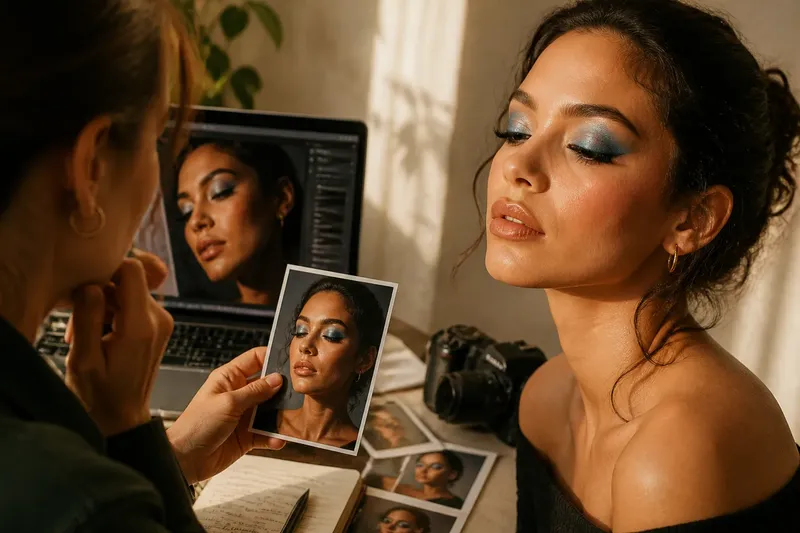
Say you are writing a caption for an invented portrait of a model wearing blue eye shadow. You notice that the cheeks look smooth, the eye makeup is crisp, and the image is cropped just below the chin. You might write: “The close crop and softened cheek texture keep attention on the blue eye shadow; the portrait presents a polished beauty look rather than documenting skin as it appears in everyday light.”
The caption distinguishes what is visible from what the image can establish. It does not claim to know how much editing happened, or whether the model’s skin looked different outside the frame. That restraint leaves room for the image to be visually compelling without treating it as evidence that a particular face is ideal.
For a quick description, check the portrait in this order: identify the crop, note the direction and quality of light, describe visible texture, then say which feature receives the strongest emphasis. Use cautious wording when the editing process itself is not disclosed. The point is not to decode every hidden decision, but to make the visible ones easier to discuss.
It is not worth trying to infer a complete editing history from a small image or to rank faces by how “natural” they seem. A concrete caption does more: it records the image’s choices and leaves beauty open to more than one interpretation. Retouching a beauty portrait can shape what a viewer sees, but naming that shaping is different from accepting the portrait as a standard.