The Compact Mirror Before the Handbag
The compact mirror before the handbag took different forms, from hand mirrors to folding cases. Learn how lids, hinges, and cosmetic compartments changed its use.
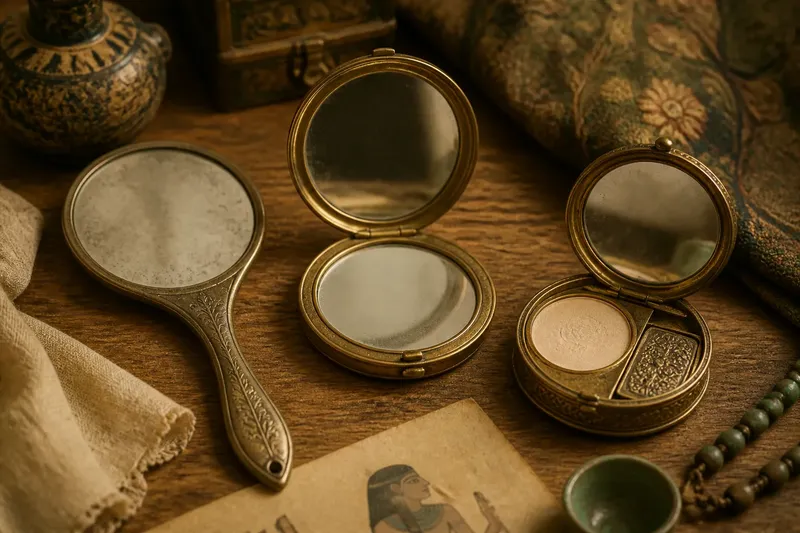
The most common mistake in tracing the compact mirror before the handbag is treating it as one object that simply grew smaller. That shortcut obscures the difference between a handheld mirror, a protected folding mirror, and a case that also held cosmetics.
Compact mirror forms
There is no single starting point for the portable mirror. In ancient Egypt, small mirrors were made from polished metal, often with a handle; examples from the New Kingdom period show how a mirror could be both a grooming tool and a carefully crafted personal object. Their reflective faces were not glass-backed surfaces, and their appearance differed from the sharper image familiar from later glass mirrors.
In ancient Greece and Rome, polished metal mirrors also circulated in handled and cased forms. Their materials, decoration, and use varied across places and periods, so they are better understood as portable mirrors than as modern compacts. The term compact can be misleading when applied to objects made long before the cosmetic case became familiar.
Later glass mirrors brought a different balance of clarity and fragility. A frame could protect the edges, while a cover or case shielded the face from scratches. These practical changes did not happen in one straight line: people continued to use different mirror materials and forms according to local craft traditions and available goods.
Handheld and folding mirrors
An uncovered handheld mirror was simple to use but exposed its reflective face when carried. A folding mirror with a lid could protect that surface and sometimes open at an angle for hands-free viewing. A mirror case with a cosmetic compartment added storage, turning two separate grooming functions into one object.
These forms answer different needs. A handled mirror offers a grip and room for a larger face; a folding design protects its surface and can stand open; a cosmetic case keeps a mirror with a powder or another grooming item. None of those features alone tells us exactly who owned an object or how often it was used.
Imagine a collector comparing three objects: a handled metal mirror, a hinged glass mirror, and a later-looking case with a powder compartment. She notes the material, whether each face is exposed or covered, and whether the interior has storage. The result is a clear description of their differences without claiming that one object must have directly evolved into the next.
Protection and decoration
A lid, sliding cover, or frame could reduce the risk of damage when a mirror was put away. The protection mattered especially when it traveled with other belongings, but a case also offered a surface for ornament. Metalwork, enamel, painted designs, and monograms could make the exterior expressive as well as useful.
Decoration does not make an object less practical. A beautifully worked case still had to open, close, and protect its contents; a plain case could serve the same purpose with less emphasis on display. A hinge might also help hold the mirror at an angle, though the exact function depends on the object’s construction.
Why carry a compact?
A portable mirror could be used to check hair, clothing, a hat, or a veil, as well as cosmetics. Its usefulness depended on the owner’s routines and the occasion, not on whether makeup was stored alongside it.
How a mirror traveled varied with clothing, containers, and custom. Pouches, personal boxes, and later bags offered different ways to carry small belongings; it would be misleading to assume that every user had a pocket or handbag. The object’s form and its surviving context are more helpful clues than a generalized story about portability.
Questions about compact mirrors?
When did compact mirrors appear?
Portable mirrors existed long before the modern cosmetic compact, including handled metal examples from ancient civilizations. Folding cases and mirror-and-cosmetic combinations belong to later design traditions, and their histories vary by region.
Did every compact hold powder?
No. Some small folding mirrors held no cosmetics, while other cases paired a mirror with a powder compartment or another grooming item. The object’s interior is essential to distinguishing those forms.
What makes a mirror portable?
Size is only part of the answer. A handle, protective cover, frame, or case could make a reflective surface easier to hold or carry, while the owner’s storage habits shaped how it was used.
How can a historic mirror be identified?
Look at its material, hinge, closure, frame, and interior, then consider any known archaeological or collection context. Wear can suggest handling, but it cannot by itself establish a precise use or owner.
Reading surviving objects
When describing a historic mirror, record what can be observed before assigning a purpose: Is the face metal or glass? Is there a cover? Does the interior include a separate compartment? If a label or collection record supplies a date and place, keep that information distinct from conclusions drawn from the object’s design.
It is not worth forcing every small mirror into a single origin story or treating “compact” as a timeless label. The useful comparison is between an exposed hand mirror, a protected folding mirror, and a case with cosmetic storage. That distinction keeps the compact mirror before the handbag grounded in visible forms rather than an unsupported timeline.
The compact mirror before the handbag was not simply a miniature dressing-room mirror: it was a set of designs for carrying and protecting a reflection. When you encounter one, begin with its material and construction, then let its documented context—not its resemblance to a familiar modern compact—guide the historical reading.