Why a Comb’s Teeth Differ Across Its Length
Learn how comb tooth spacing suits different hair and grooming tasks, so you can choose a comb that detangles, parts, smooths, or shapes with less snagging.
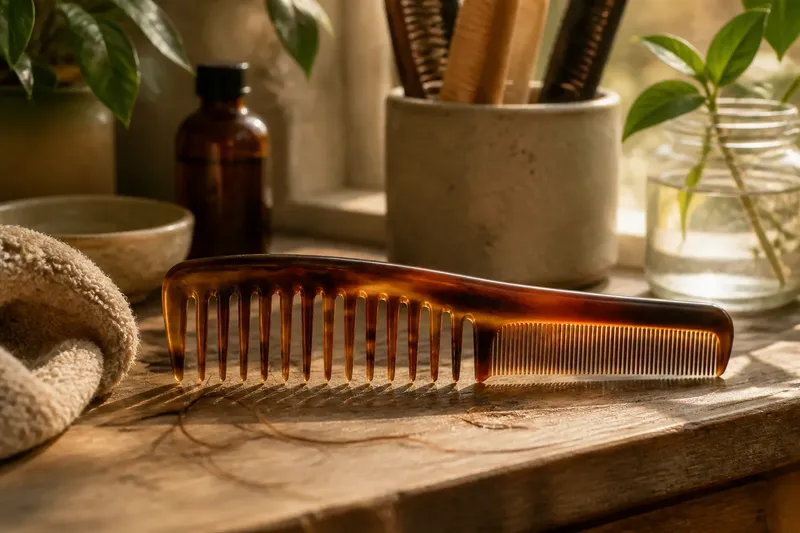
The common mistake with a comb is choosing by color, handle, or the neatness of its silhouette, then asking one set of teeth to do every job. A comb with varied spacing is designed around different kinds of contact: wider gaps can move through fuller sections, while closer teeth can gather and smooth finer strands. Choosing by hair and action helps you avoid needless pulling and gives each part of the comb a clear purpose.
Read the tooth pattern
Look along the comb from one end to the other. A common design has a wide-tooth section and a fine-tooth section, sometimes separated by a handle or a narrower transition. Other combs shift gradually from broad gaps to close ones, or place a row of evenly spaced teeth on both sides of a grip.
The spaces between teeth matter as much as the teeth themselves. Broad gaps let thicker sections pass without being divided into many small strands. Close gaps catch more individual hairs at once, which can help with smoothing or precise placement, but may snag if you pull them through a dense knot.
Tooth thickness and tip shape also affect the feel. Rounded, smooth tips are generally more comfortable against the scalp than sharp or rough edges. A comb’s material and finish matter, too: inspect for seams, chips, or burrs that could catch hair, especially if the comb is used near the ends.
Choose by hair situation
Hair type is only part of the choice. Length, density, curl pattern, dampness, and the task at hand all change how a comb moves. Start with the section you need to handle, rather than assuming that one label such as “fine” or “thick” settles the question.
- For wet, curly, or easily tangled hair: Start with wide teeth and small sections. The larger spaces can help you work through strands without forcing them into a tight row; use a suitable detangling method for your hair and avoid yanking at a knot.
- For dense, coarse, or long hair: A sturdy wide-tooth comb is often the more comfortable starting point for separating sections. If you want a smoother finish afterward, try the fine end only where it passes freely.
- For fine or straight hair: A fine-tooth section can gather and align strands for a part or a smooth surface. If the hair is fragile, the close spacing may create more tension than you want, so use light pressure and stop if it catches.
- For short hair or facial hair: A compact comb with closer teeth can give control over small areas. If the hair is dense or the comb drags, choose wider spacing instead of forcing a narrow section through.
- For mixed textures or changing tasks: A comb with both wide and fine sections offers options in one tool. Let the wide end handle separation and reserve the close end for finishing only when it glides comfortably.
These are starting points, not strict categories. Two people with similar hair may prefer different spacing because one is detangling damp curls while the other is shaping dry hair. Notice whether the comb moves smoothly, catches at the same point, or leaves the section more tangled than before.
Match spacing to action
Detangling: Begin with wide teeth and work through a manageable section, starting near the ends and moving upward as the tangles loosen. The goal is to separate knots without asking the comb to pull through the full length at once.
Parting: Use the pointed handle of a tail comb or the edge of a close-tooth section to mark a line. A tail is useful for accuracy, but the teeth are not automatically right for every hair texture; use a spacing that can follow the line without snagging.
Smoothing: Fine teeth can gather short, loose hairs and help arrange a surface. They work best when the section is already reasonably untangled. If the comb stops or lifts hair from the scalp, switch to wider teeth rather than pressing harder.
Shaping: For setting a style or arranging hair around a part, choose the spacing that gives enough control without flattening or separating the section more than you intend. Broad teeth leave more room between strands; close teeth create a more compact grouping.
Distributing product: A wide-tooth comb can help spread conditioner or styling product through a section, particularly when the hair is wet or textured. Use a comb that is easy to clean, and follow the product directions where they specify an application method.
When does each section fit?
Should I use a wide-tooth comb on wet hair?
A wide-tooth comb is often a gentle starting point for damp or wet hair, especially when it tangles easily. Work in sections and use light pressure; if the comb catches, loosen the knot with your fingers or adjust the method instead of pulling through it.
When should I use fine teeth?
Use fine teeth for tasks that need close control, such as making a tidy part or smoothing a section that is already detangled. They are less suitable for forcing a comb through dense knots or a section that resists.
Does curl pattern decide the spacing?
Curl pattern can influence how hair catches and separates, but it does not determine the choice by itself. Length, density, dampness, and whether you are detangling or finishing also matter, so test the comb gently on a small section.
Can one comb do every job?
A comb with wide and fine sections can cover several everyday tasks, especially if your hair needs both detangling and smoothing. It may not replace a specialized comb when you need a very pointed part, a broad grip, or a shape suited to a particular styling method.
Check the comb itself
Before choosing, run your fingers along the teeth and inspect the spaces in good light. Look for smooth edges, consistent spacing, and a shape that lets you hold the comb steadily. A sturdy handle can help with control, but it should not make the teeth difficult to guide through the section.
Material is a practical consideration, not a beauty ranking. Plastic combs are widely available and easy to carry; wood and other materials may feel different in the hand. Whatever the material, avoid a comb with cracked teeth or a rough seam that catches strands. For cleaning and use on particular hair treatments, follow the product label or manufacturer’s directions.
Say you have thick, wavy hair that tangles at the nape and a comb with wide and fine ends. Start with the wide end on a small, damp section, easing through the ends before moving upward; once the section is loose, use the fine end only to smooth the surface if it passes without catching. The observable difference is whether the comb separates the hair comfortably rather than stopping at the same knot or pulling the section tight.
Skip the perfect match
It is not worth buying a collection of combs just to cover every possible hair type or styling trend. A sound, comfortable comb with spacing suited to your regular tasks is more useful than a dramatic shape you rarely reach for. If a particular job needs more precision, add a second comb for that job rather than expecting one tool to behave identically from tip to tip.
For a quick choice, match the comb’s teeth to the action first: wide spacing for separating and detangling, closer spacing for controlled smoothing or placement. Then consider how your own hair responds, and let a snag-free, comfortable pass guide the decision. That is the useful point of varied tooth spacing—and the reason the comb’s shape is more than decoration.